What Is an ERP System? Meaning, Examples, Types, and How It Actually Works
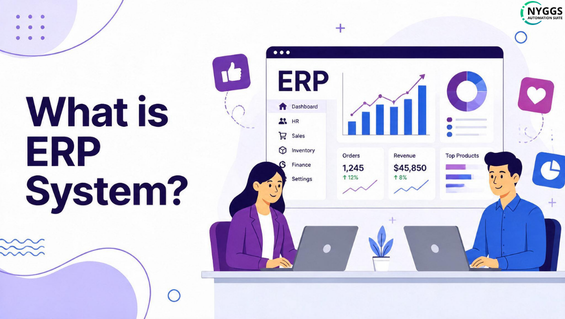
ERP stands for Enterprise Resource Planning. In plain terms, an ERP system is one central platform that brings together all the core functions of a business — finance, sales, inventory, HR, and operations — into a single, connected system.
Instead of juggling multiple disconnected tools and spreadsheets, teams work from the same real-time data, which reduces errors, saves time, and gives leadership a clear view of how the business is actually performing.
Why Businesses Use ERP Systems
As companies grow, managing operations across different departments becomes harder. An ERP system solves this by centralizing data and automating repetitive processes, so every department is working with accurate, up-to-date information.
- Centralized data across finance, sales, and inventory.
- Improved decision-making with real-time reporting.
- Reduced manual work through process automation.
- Better collaboration between departments.
Types of ERP Systems
ERP systems generally come in a few forms — cloud-based, on-premise, and hybrid — each suited to different business sizes and needs.
"The goal of an ERP system isn't just to store data — it's to turn that data into decisions."
Choosing the right ERP depends on your company's size, industry, and how much customization your workflows require.